February 27th, 2026 | 5 min read
By
.png)
Noise is the number one complaint in most offices.
In open and hybrid workplaces, sound travels farther than expected, lingers longer than it should, and accumulates throughout the day, quietly undermining focus and communication. Most teams adapt to it without realizing how much mental energy they are spending simply managing their environment.
The good news is that common office noise issues are predictable and can be addressed with thoughtful acoustic planning rather than a major renovation. Below are the most frequent challenges we see and how to solve them.
TL;DR (Summary)
- Open and hybrid office layouts amplify sound, making noise control a design priority rather than an afterthought.
- Echo and reverberation occur when sound reflects off hard surfaces instead of being absorbed.
- Privacy issues in open offices are often caused by sound transfer between desks and between desks and rooms.
- Mechanical equipment and everyday activity create a cumulative background noise that affects concentration.
- Strategic acoustic solutions can significantly improve comfort, clarity, and productivity without major construction.
Echoes and Reverberation in Open Spaces
Large rooms with high ceilings, glass walls, concrete floors, and minimal soft surfaces tend to amplify sound. When voices reflect repeatedly off hard surfaces rather than being absorbed, they create echoes and reverberation that make conversations less clear and meetings more fatiguing.
You may notice this most in conference rooms where every comment seems to linger slightly, or in open collaboration areas where multiple discussions blend into a steady wash of background sound. Over time, that constant reverberation makes it harder for employees to distinguish speech and stay engaged. Even short meetings can feel longer than they are simply because participants are working harder to listen.
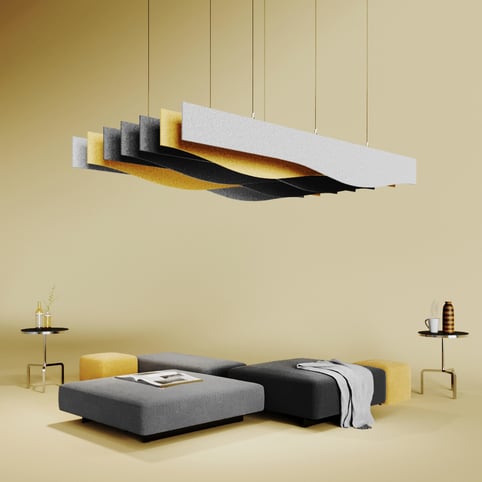
Acoustic wall panels and ceiling baffles are designed to interrupt this cycle. By absorbing sound at key reflection points, they reduce echo and improve clarity without altering the room's layout. Installing panels in meeting spaces, collaborative zones, and along large, uninterrupted walls can significantly improve the space's performance while maintaining its design intent. In larger open ceilings, suspended acoustic elements can also help manage vertical sound reflection, which is often overlooked in modern office design.
In spaces with extensive glazing, window treatments can also contribute to sound absorption. Fabric-based shades or drapery systems soften what would otherwise be highly reflective surfaces, improving acoustics while also addressing glare and light control. While window treatments are often selected for aesthetics or solar performance, they can quietly improve a room's overall acoustic balance when intentionally specified.
Sound Transfer Between Workstations and Rooms
In open offices, sound rarely stays contained. Conversations at one desk can be heard several workstations away, and meetings inside enclosed rooms may carry into adjacent spaces if walls or partitions lack acoustic performance.
This becomes particularly challenging in environments that require privacy or extended concentration. Employees may step away for calls, lower their voices unnaturally, or avoid sensitive discussions altogether. Over time, these small behavioural shifts disrupt workflow and reduce efficiency.
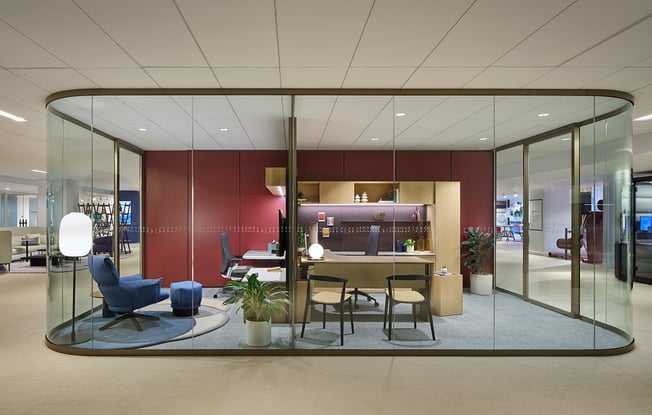
Partition systems are one of the most effective tools for managing sound transfer. Full-height modular walls and acoustic-rated glass systems help block and absorb speech while preserving natural light and visual openness. Because modular wall systems are adaptable, they allow you to create enclosed offices, meeting rooms, or quiet areas without permanent construction, and they can evolve as your team grows or reconfigures. This flexibility is especially valuable in growing organizations where headcount and team structures change over time.
In shared environments, adding acoustic desk screens between workstations can significantly reduce direct sound paths and create a greater sense of privacy without isolating individuals from their teams.
For larger open areas where conversations overlap throughout the day, sound masking systems can further improve speech privacy. By introducing a consistent, calibrated background sound, sound masking reduces the intelligibility of nearby conversations, making distractions less noticeable and helping employees maintain focus. When integrated properly, sound masking works in tandem with physical acoustic treatments rather than replacing them.
The goal is not to eliminate interaction, but to create intentional acoustic boundaries that support both collaboration and concentration.
Mechanical Noise from Equipment
Printers, copiers, HVAC systems, and other office equipment generate a steady mechanical hum that often fades into the background until it becomes a constant distraction. When several devices operate in the same open area, their combined noise can spread across the workspace, particularly in offices with limited acoustic treatment.
Employees seated near high-use equipment tend to feel the impact most, as even low-level mechanical noise can make sustained concentration more difficult over a full day. We see this most often in offices where print areas were added later and never acoustically separated. What begins as a convenient central location can gradually become one of the most disruptive zones on the floor.
Containing sound at its source is usually the most practical solution. Installing acoustic panels around print stations, creating partially enclosed equipment zones using modular wall systems, or relocating high-volume machines away from primary work areas can significantly reduce their impact. These adjustments are often simple but deliver noticeable improvements in overall comfort.
Everyday Background Activity
Not all office noise is dramatic. Much of it comes from daily movement and routine activity: footsteps across hard floors, chairs sliding in and out, keyboards clicking, and phones ringing from across the room. Individually, these sounds are minor. Collectively, they create a continuous acoustic layer that competes for attention.
In busy open-plan environments, this subtle buildup of noise can make deep focus feel just out of reach, especially for employees doing analytical or creative work.
Strategic acoustic panels throughout the space help reduce overall reverberation, softening the impact of everyday activity. Flooring choices also play a meaningful role. Carpet tile flooring, particularly in high-traffic zones and workstation areas, absorbs impact noise and reduces the sharpness of footsteps and chair movement while adding durability and design flexibility. Compared to hard surface flooring, carpet tile significantly reduces both airborne and impact sound, making it one of the most effective foundational acoustic decisions in an open office.
Creating designated quiet zones within larger offices also supports focus. Office pods are an effective solution when permanent construction is not ideal. These enclosed or semi-enclosed units provide a controlled acoustic environment for calls, virtual meetings, or heads-down work, offering employees immediate access to privacy within an open floor. Since pods are modular, they can be relocated or expanded as needs change, allowing the acoustic strategy to evolve alongside the workplace.
Designing a Workplace That Sounds as Good as It Looks
Office acoustics influence how people experience their workplace every day. With targeted acoustic treatments such as acoustic panels, modular walls, sound masking systems, office pods, carpet tile flooring, and window treatments, you can shape how sound behaves within your existing layout.
In most cases, meaningful improvement does not require a complete redesign. It requires identifying where sound is reflecting, travelling, and accumulating, then introducing solutions that support how your team actually works.
If noise continues to disrupt focus or privacy in your space, we can help you identify the source and implement strategic acoustic solutions that support the way your team works. Contact us today to get started.

